
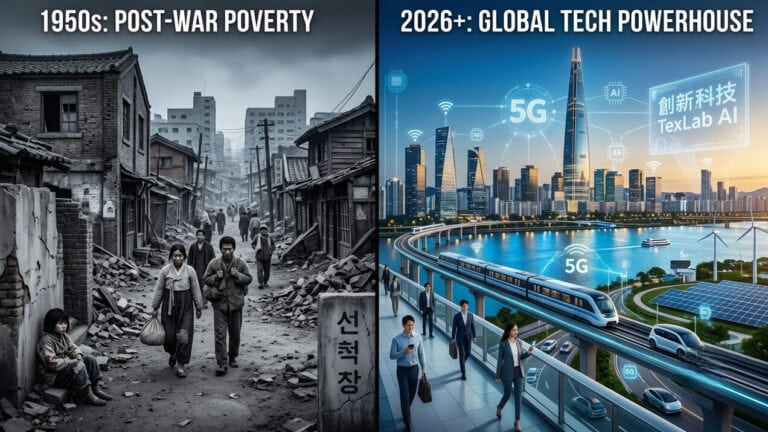
In the middle of the twentieth century after the horrific Korean War of the 1950s South Korea was one of the poorest countries in the world. Having no natural resources vast territory or established industrial infrastructure no economist of that time could predict that this East Asian country would one day dominate the global economy.
And standing in 2026 the entire modern world economy is incomplete without East Asian innovation! The smartphones in our hands high speed 5G networks in cities or modern Artificial Intelligence AI driven advanced memory chips South Korea today stands tall as a top technology giant in everything.
What was the story actually like of rebuilding itself from post war poverty to becoming an undisputed digital leader? Analyzing the history of South Korea’s technology development shows that it is a unique example of far reaching state planning corporate efficiency huge investment in education and uninterrupted digital innovation.
The Origin: The Miracle on the Han River Case Study
The foundation stone of South Korea’s digital dominance today was laid between the 1960s and 1980s a rapid economic transformation called the “Miracle on the Han River Case Study”. Having no oil iron or adequate agricultural land the South Korean government played a bold and calculated move: human resource development and export oriented industrialization would be their only way to bounce back.
Under government initiative the country quickly focused on heavy industry electronics and manufacturing. Suitably selected large family owned business conglomerates state wise called Chaebols were given special loans tax exemptions and protective benefits.
[1950s: Post-War Poverty]
│
▼
[1960s-80s: Heavy Industrialization & Chaebol Rise]
│
▼
[1990s: National Broadband & Semiconductor Focus]
│
▼
[2020s-2026+: Global Tech & AI Hardware Dominance]
Among these business conglomerates were Samsung LG and Hyundai whose main goal was to capture the international market. Instead of depending on foreign products they started manufacturing their own electronic products which built the strong foundation of today’s global technology supply chain.

1. Corporate Titans: How Samsung Became a Tech Giant
Observing the history of Samsung turning into a global giant is essential in reviewing the rise of South Korea. Starting its journey as a simple trading company of dried fish and local items in the initial stage Samsung strategically entered the electronics industry in the late 1960s.
Without being limited as a low cost contract manufacturer for Western brands the top leadership of Samsung took a landmark decision in the late 1980s: extreme commitment to hardware quality improvement bold research and development R&D and global brand expansion.
When the consumer electronics industry was transforming from analog to digital in the late 1990s Samsung took rapid strategic steps. They invested billions of dollars in capital in flat panel displays mobile handsets and home appliances. Currently Samsung is not only a top name in the global consumer electronics sector but also the primary hardware competitor of Apple in the mobile smartphone industry worldwide.
💡 My Observation & Personal Opinion: The most admirable aspect of Samsung’s growth strategy is their long term foresight. During economic recessions when most global technology companies cut down their R&D budget the South Korean tech giants increased their research budget instead. Because of this high risk and high reward mindset even though traditional Western giants stalled during industry transformations they rapidly captured market share for themselves.
2. Silicon Supremacy: South Korea Semiconductor Dominance
If software is considered the brain in the modern digital age then semiconductors or semiconductor chips are its main driving force. One of the pillars maintaining the commercial influence of South Korea in the global economy in 2026 is their monopoly dominance in the semiconductor industry.
In the late 1980s even though establishing a semiconductor factory seemed extremely capital intensive and risky for any Asian country outside Japan South Korean companies courageously invested massive capital into DRAM and NAND flash memory chip technology.
Currently led mainly by Samsung Electronics and SK Hynix South Korea directly holds more than 60 percent share of the global memory chip market.
Global Memory Semiconductor Market Share (2026 Estimate):
┌──────────────────────────────────────────────────────────┐
│ ███████████████████████████████████████░░░░░░░░░░░░░░░░ │
│ South Korea (Samsung & SK Hynix): ~60-70% │
│ Rest of the World Combined: ~30-40% │
└──────────────────────────────────────────────────────────┘
Along with the rapid expansion of global Artificial Intelligence AI infrastructure High Bandwidth Memory HBM chips manufactured in South Korea are serving as the core driving force of AI processing clusters worldwide.
3. World-Class Digital Infrastructure and 5G Leadership
Simply manufacturing hardware is not one hundred percent of success having world class digital infrastructure inside their own country was essential to becoming a true South Korea Tech Powerhouse.
In the late 1990s when people in most countries of the world were struggling to connect to the internet with slow dial up modems the South Korean government declared high speed broadband internet as a basic civic facility of the country! They laid high speed fiber optic cables in every city subway metro tunnel and every alleyway of villages.
This hyper connected environment inside the country turned South Korea into a living laboratory or “living testbed” for testing any new digital service. As a result:
- South Korea achieved the milestone of almost 100% smartphone usage as one of the top countries in the world.
- They launched the first commercial and public 5G network in the entire world.
- Many years before the rest of the world could understand citizens of their country happily accepted mobile payments E sports and cloud streaming.

💡 My Observation & Personal Opinion: Having a tech savvy domestic user base brings a huge “unfair advantage” or extra benefit for South Korean tech companies. When a local company launches a new mobile app digital service or smart home device in Seoul lakhs of tech savvy people in the country start using it in reality and providing feedback right away. Due to this fast review system companies get the opportunity to fix all errors or glitches completely before releasing products into the global market!
Comparative Breakdown: Key Factors Behind South Korea’s Tech Success
A comparative analysis of their core strategic pillars is presented below to understand the strategy behind South Korea’s historical success compared to other emerging economic superpowers:
| Strategic Element | Traditional Developing Country Approach | South Korea’s Strategic Blueprint |
| National Focus | Relying on low cost agriculture and export of raw natural materials | Specific expansion of high tech manufacturing and R&D sector |
| Education Strategy | Basic initial education only without technological foresight | Sole priority on STEM engineering and modern digital skills |
| Corporate Model | Fragmented small domestic business dependent model | Providing institutional support to global export oriented Chaebols like Samsung and LG |
| Infrastructure | Slow speed and sluggish policy in reforming digital infrastructure | State driven advance expansion of 5G and fiber optic networks |
| Global Goal | Fulfilling domestic consumer demand only | Producing premium technology hardware for the international export market |
The Challenges Facing South Korea’s Tech Future
Despite maintaining global dominance South Korea is facing several new challenges in the period beyond 2026:
- Regional Trade Competition: Rapid technological expansion of neighboring competitive markets is creating severe challenges for South Korea’s flat panel display and EV battery market share.
- Aging Population and Labor Crisis: As a result of an alarming decline in birth rates a long term shortage of skilled workers is appearing in the country which is forcing companies to automate their manufacturing plants with AI and advanced robotics.
- Geopolitical Supply Chain Crisis: As semiconductor and chip manufacturing currently becomes one of the most important issues of international national security South Korean processor manufacturers have to handle global trade dynamics with extreme caution.
Conclusion: The Ultimate Tech Playbook
Transforming from a post war impoverished country into today’s global tech giant South Korea’s invincible journey is one of the greatest economic successes in modern history. Through a combination of aggressive government planning boldness of large corporate companies world class digital infrastructure and extreme commitment to education South Korea has created a flawless blueprint for the digital revolution.
In 2026 and the period beyond as Artificial Intelligence AI advanced robotics and next generation semiconductors reshape the entire world South Korea will continue to reign as one of the primary architects of our digital future.
Frequently Asked Questions (FAQ)
1. What does the word “Chaebol” mean in South Korea’s technology history? Answer: Chaebol basically refers to the large family owned business conglomerates of South Korea. Companies like Samsung LG and Hyundai are prime examples of this. Receiving direct support from the government to build heavy industry export infrastructure and technology research labs these massive institutions played the core role in the country’s economic development.
2. Why is South Korea so extremely important for the AI and smartphone industry worldwide? Answer: South Korea alone manufactures more than 60% of the world’s total memory chips DRAM and NAND flash connected with their advanced High Bandwidth Memory HBM chips. Without these hardware parts made by Samsung and SK Hynix global tech companies cannot build modern smartphones or high end computers nor can they even train any complex AI model!
3. How did the South Korean government help in the country’s technological rise? Answer: Instead of being a silent spectator the Korean government worked as an active catalyst in tech development. They heavily subsidized technical education funded national research institutes declared high speed internet as a national priority and built modern digital infrastructure which transformed the entire country into an early test ground for new technology.

Faysal Ahmed is the founder of TexLab AI and regularly writes about AI tools, technology, freelancing, and digital productivity. He has hands-on experience testing AI applications and reviewing online tools.