

Artificial Intelligence AI was considered the greatest time saving technology of our modern era. Through email drafting complex code generation and massive dataset analysis modern tools like ChatGPT Claude or Gemini promise to shrink manual work time to a few seconds.
Yet in this modern workplace of 2026 professionals content creators and entrepreneurs are facing an exceptional experience: despite using AI technology every day their working hours have not decreased. Rather most working people are feeling more busy and mentally stressed compared to before.
This psychological and technological contradiction is known as the AI Productivity Paradox. Although AI is capable of completing a single task quickly overall it creates new processing bottlenecks cycles of unnecessary prompt tuning and mental fatigue.
In this comprehensive guide we will analyze exactly why people are failing to save time with AI which human behaviors are responsible behind this paradox and what practical changes you need to reclaim your daily work schedule.
What is the AI Productivity Paradox?
The concept of Productivity Paradox in the tech world is not new. In the late twentieth century when personal computers were first introduced in corporate sectors overall institutional productivity did not increase instantly due to spending a lot of time behind learning new software and fixing technical errors.
At present a similar illusion is being created in the case of AI technology. Because a 1000 word text is generated in three seconds we consider ourselves extra productive. However considering constant prompt engineering verifying factual errors or hallucinations of AI output formatting and option paralysis it is seen that at the end of the day the actual amount of saved time drops to zero or takes a negative form.
1. The Endless “Prompt Tweaking” Loop
The biggest trap of wasting time for AI users is a kind of illusionary confusion of speed. A user suddenly writes a short prompt receives a average or ordinary output from AI and then spends the next 20 minutes changing keywords adding various rules and re-generating new answers repeatedly.
The draft which could have been written by hand in 15 minutes using personal experience the user wastes 25 minutes instead being desperate to get it written through AI.

💡 My Observation & Personal Opinion:
If I am not conscious myself I fall into this trap sometimes. It is very easy to confuse the difference between being busy and getting actual work done. If an AI tool cannot give you a usable draft or framework even after giving prompts 2 to 3 times then stopping the useless fight with the chatbot and manually fixing that raw draft using your own knowledge and experience is much faster. Knowing that boundary of how long you will pull with AI and when you will jump in yourself is crucial!
2. The Illusion of Infinite Content (Parkinson’s Law)
According to Parkinson’s Law: as much time as is allocated to complete any work the work continues to expand exactly that much. Coming into the era of AI a similar problem has appeared and that is extra content generation or content expansion.
Before AI came maybe a blogger published 2 high quality articles or posts per week. But after getting AI he tries to write 10 posts per week. Since creating content has become as easy as water teams are now making a mountain of unnecessary slide decks low importance reports and extra social media content without need simply because the opportunity is there.
The Over-Production Trap:
- More output \neq More value: Filling your work environment with low quality AI drafts makes the burden of editing or proofreading mountain-like at the end of the day.
- Review bottleneck: No matter how much content AI generates at the end of the day some human has to read every writing verify factual information and give the final approval!
3. The Hidden Cost of Fact-Checking Hallucinations
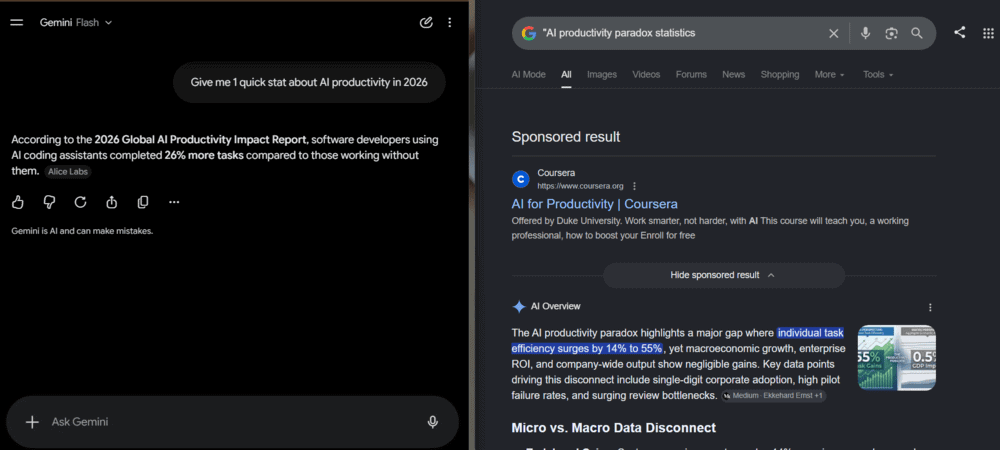
AI language models are built based on matching probable patterns not based on any absolute truth. They can construct false information citations of fake statistical sites and incorrect historical data with one hundred percent confidence.
If you publish or send AI generated outputs directly without verifying their truthfulness there remains a severe risk of ruining your professional reputation. But the trouble is going deep into fact checking the stories or data made up by AI often takes twice as much time compared to writing the entire text manually from scratch anew!
💡 My Observation & Personal Opinion:
Relying blindly on AI information in fields like tech blogging medical research or SEO is extremely dangerous. The smartest workflow for using AI is not to ask for truth or facts directly from AI but rather to input your own researched factual data into AI and ask it to organize arrange or proofread them beautifully. Use AI not as an unreliable researcher but rather as an experienced editor!
4. Lack of Workflow Integration and Context Switching
Constantly jumping between 5 different AI tools for individual tasks such as one for writing one for images one for audio and another for coding creates tremendous mental fatigue. Moving back and forth through browser tab after tab completely destroys deep focus or intense concentration on work.
If the AI tools you use are not directly integrated with your main workspace such as your CMS IDE or document editor then the time wasted just doing copy paste fixing markdown formatting and matching broken layouts will completely ruin the time saved through AI.

Traditional AI Workflow vs. Optimized Strategic Workflow
To overcome the AI productivity paradox a strategic shift in using artificial intelligence is mandatory. A comparative analysis between the working methods of time wasting ordinary users and successful AI strategists is presented below:
| Evaluation Field | Time Wasting Traditional AI Workflow | High Performing Optimized Strategic Workflow |
| Primary Goal | Expecting a 100% finished or final output directly from AI | Using AI to build a draft or core framework 60% baseline |
| Prompting Style | Inputting approximate prompts without contextual information or context | Applying specific and pre prepared prompt templates |
| Fact Checking | Spot checking or partial verification of information after content generation is completed | Supplying your own tested and truthful information to AI before generation |
| Focus Area | Producing massive amounts of low quality generic content | Increasing content quality by adding human experience strategy and unique perspectives |
How to Reclaim Your Time: A Practical Blueprint
Follow the practical guidelines below to save more than 10 hours per week through artificial intelligence in 2026:
- Build Reusable Prompt Templates: Instead of drafting new prompts constantly keep your best previously tested prompts saved in a specific snippet manager.
- Set a “Two-Prompt” Limit: After a maximum of two prompt iterations if you do not get the desired result start editing manually without wasting time with the chatbot.
- Focus on E-E-A-T: Always add personal observations screenshots of real testing and human experience in your writing which AI is completely unable to generate.
Conclusion: Quality Over Quantity
The AI productivity paradox is not a limitation of technology rather it is a defect of human strategy. AI is basically a force multiplier however multiplying zero strategy always results in zero. Avoiding the mindset of producing unnecessary massive amounts of content and focusing on well organized human controlled editing makes it possible to get freedom from the prompt cycle and achieve true time saving productivity.
Frequently Asked Questions (FAQ)
1. Does using AI tools actually decrease human creativity over time?
Answer: Not necessarily. If used correctly AI only performs repetitive mechanical tasks such as formatting initial outline generation and proofreading. This saves brain power and helps focus on high quality creative strategy fundamental research and storytelling.
2. How can I ensure AI doesn’t hallucinate false information in my articles?
Answer: The most effective method is “Grounding”. Instead of asking open questions to AI supply trusted information sources directly inside the prompt and give instructions to generate a summary based only on that specific context.
3. Should I completely avoid AI detectors when editing my content?
Answer: No there is no need to worry excessively about AI detectors. Search engines like Google prioritize content utility accuracy of information and user value over artificial AI scores. As a result instead of trying to bypass detectors you should focus on adding original screenshots data tables personal observations and a flawless structure to the article.

Faysal Ahmed is the founder of TexLab AI and regularly writes about AI tools, technology, freelancing, and digital productivity. He has hands-on experience testing AI applications and reviewing online tools.